You pick up a new car on a Friday and the paint looks flawless. Six weeks later, after a few highway commutes behind a gravel truck, there’s a tiny white pit on the hood. Then another near the bumper. Nothing dramatic, but once you notice them, you can’t stop seeing them.
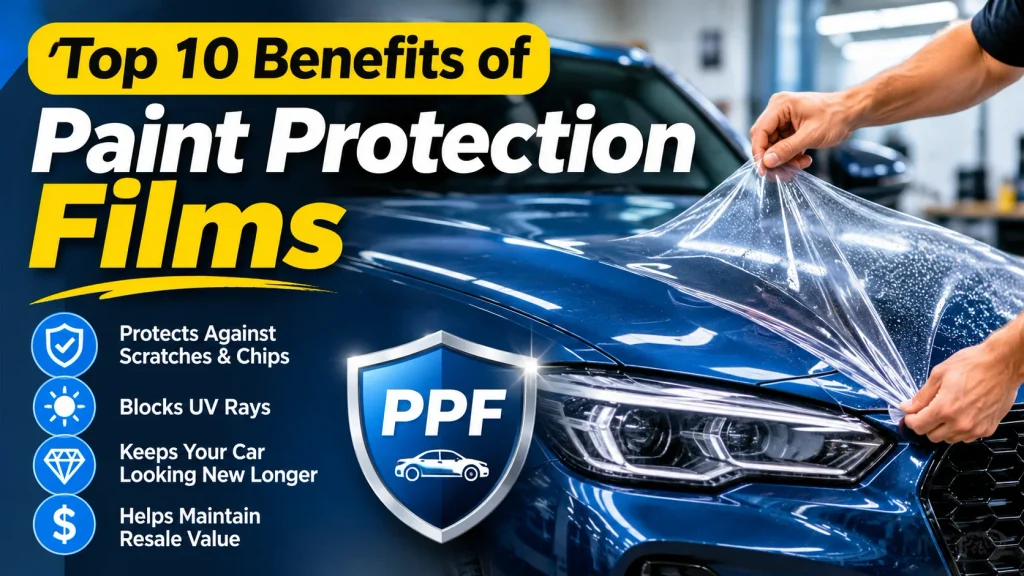
That slow buildup of chips, scuffs, and stains is exactly what paint protection film (PPF) is meant to slow down. PPF is a clear, flexible urethane layer applied over your paint so the film takes the hit instead of the paint. It isn’t magic and it isn’t cheap, but it is one of the few products that offers real physical protection.
This guide covers the 10 benefits of paint protection films that hold up under scrutiny, plus what many guides skip: cost, limitations, how PPF compares with ceramic coating, and who should probably pass. When a claim comes from a manufacturer rather than independent testing, we say so.
What Is Paint Protection Film (PPF)?
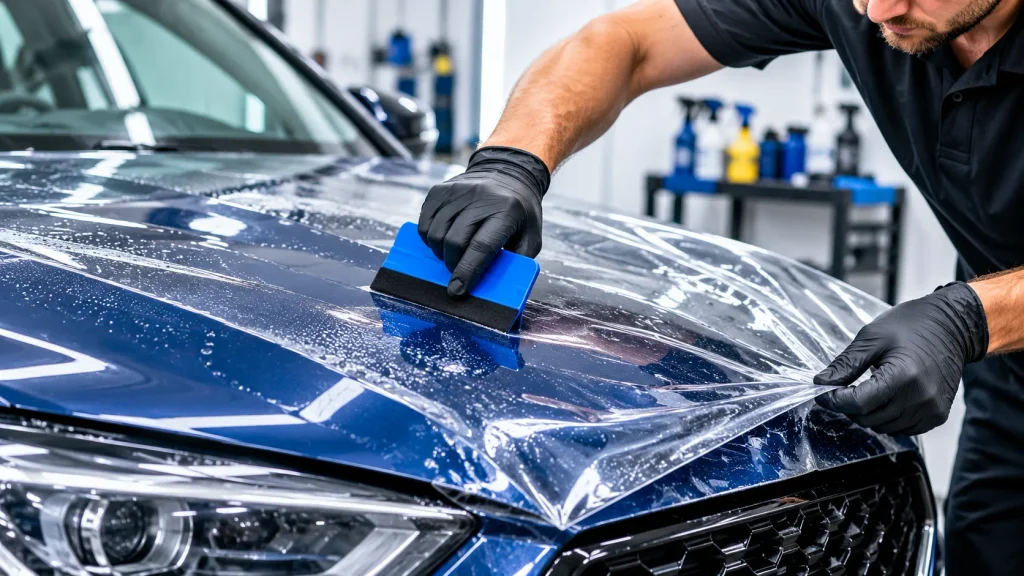
Paint protection film, also called clear bra, is a transparent, flexible layer of thermoplastic polyurethane applied directly to painted surfaces. It has an adhesive on one side and a protective topcoat on the other. Many premium films are around 8 mil thick (about 0.2 mm).
Think of it as a screen protector for your car. A small stone strikes the film, the film absorbs the energy, and the paint underneath stays intact. Unlike wax or ceramic coating, which mainly help with contamination and cleaning, PPF is designed to absorb minor physical impacts.
Installers cut the film to fit each panel, using either pre-programmed patterns for specific models or hand-cut pieces, then smooth it onto clean, prepared paint. Quality of that prep and fitting matters as much as the film itself.
Common coverage options:
- Partial front: bumper, mirrors, and the leading edge of the hood and fenders.
- Full front: the entire hood, front fenders, bumper, and mirrors, often with headlights.
- Track or enhanced package: full front plus rocker panels and other impact zones.
- Full body: nearly every painted exterior panel.
PPF also comes in gloss, satin, and matte finishes, and in colors, so it can change a car’s look as well as protect it.
Top 10 Benefits of Paint Protection Films
1. Protection Against Rock Chips and Road Debris

This is the headline benefit and the main reason most people buy PPF. When a stone hits a protected panel, the film takes the impact first, which lowers the chance of a chip in the paint below. The front bumper, hood, fenders, and mirrors take the most abuse, so that’s where film earns its keep.
Real-world example: a commuter doing 70 mph on a busy interstate, or a driver following dump trucks through a construction zone, is exposed to far more flying debris than someone who mostly drives city streets.
Limitation: PPF is not an invisible force field. A sharp or heavy strike can tear or puncture the film, and that section may need to be replaced.
Who benefits most: highway commuters, road-trippers, and anyone who regularly drives on gravel or in construction areas.
2. Defense Against Everyday Scratches and Scuffs
Most paint damage isn’t dramatic. It’s a grocery bag dragged across a bumper, luggage on the trunk edge, or fingernail marks around door handles. The film takes those light abrasions instead of the paint. It can also reduce the swirl marks that come from washing, since you’re washing the film rather than the clear coat.
Limitation: deep gouges, keying, or sharp objects can cut through film.
Who benefits most: owners who park on the street, in tight garages, or in busy lots.
3. Self-Healing Properties of Modern PPF

Many premium films have an elastomeric topcoat. When warmed by sunlight or warm water, the surface relaxes and light scratches and swirl marks fade. XPEL’s care guidance for its Ultimate film says light scratches self-heal in about 20 to 30 minutes at room temperature, and that warm water around 120°F speeds things up in colder weather. That’s a manufacturer claim, but it matches what editorial sources describe.
Limitations: self-healing only works on light surface marks. Deep cuts and punctures don’t heal. Not every film has this feature, and some installers report that healing slows as the film ages.
Who benefits most: owners of dark or high-gloss paint, where light marks are most visible.
4. Resistance to Bug Splatter, Bird Droppings, and Road Contaminants
Bugs, bird droppings, tar, and tree sap can stain or etch an unprotected clear coat if they sit. With PPF, the contaminant lands on the film. Modern films also resist staining from bugs, bird droppings, and road grime.
Limitation: the film can stain too, especially if neglected. XPEL advises removing insect and other stains as soon as possible. “Protected” doesn’t mean “ignore it for a month.”
Who benefits most: drivers who park under trees, take summer road trips, or live in rural areas.
5. Easier Cleaning and Maintenance
Many films have a smooth, hydrophobic topcoat that helps dirt rinse off more readily, and a protected front end is less prone to the baked-on bug residue that’s hard to remove from paint.
It’s still not maintenance-free. Installer guidance on the first wash ranges from 48 hours (XPEL) to about a week (3M), so follow your installer’s instructions. After that, hand washing is best, and XPEL says to avoid using a pressure washer or high-pressure water near the film’s edges because it can cause lifting.
Who benefits most: owners who want to spend less time chasing stubborn contamination, as long as they’re willing to wash gently.
6. Keeps the Original Paint Intact and Looking Like the Factory Finish
A well-installed gloss film is close to invisible, so you keep the factory look while protecting it. That matters because original paint is hard to replicate. Repainted panels rarely match factory texture and color perfectly, and enthusiasts and collectors often care about originality.
If you want a different look, satin, matte, and colored films are available. Just note that a matte film on glossy paint changes the car’s appearance, so ask to see a sample first.
Who benefits most: owners of luxury cars, sports cars, and enthusiast vehicles.
7. Helps Preserve Resale Value (With Caveats)
Buyers notice paint condition quickly, and a front end free of chips signals a well-kept car. PPF can help you get there.
But be careful with the claim. Motor1 is clear that PPF doesn’t guarantee a higher resale price, and we found no independent study quantifying the effect. Think of it as protecting the condition that supports resale value, not as a guaranteed return. If you plan to sell, keep the installation invoice and ask whether the warranty transfers to a new owner.
Who benefits most: owners who keep a car three to six years and sell it privately or at trade-in with clean paint.
8. Protection From Sun Exposure and Surface Wear
Film adds a barrier between the clear coat and sun, rain, road salt, and grit. Manufacturers such as 3M advertise protection against stone chips, scratches, bug damage, road tar, and weathering.
Treat the UV and fading benefit as secondary. We found no independent test data quantifying it, and modern factory clear coats are already formulated to resist UV. Where film clearly helps is as a sacrificial surface against wear. Make sure the film itself is rated to resist yellowing, which is what a good warranty covers.
Who benefits most: owners in high-sun states such as Arizona, Texas, and Florida who park outdoors.
9. Customizable Coverage for Your Budget and Risk

You don’t have to wrap the whole car. Many owners start with a partial or full front, then add rocker panels, door edges, door-handle cups, the trunk ledge, or A-pillars.
That flexibility is a real advantage, because the high-impact areas are a small share of the total surface. Motor1 suggests protecting the front bumper, hood, fenders, and mirrors as a sensible middle ground for most drivers.
Who benefits most: budget-conscious owners who want the most protection per dollar.
10. Potential Savings on Touch-Ups and Repaints
Paint repair adds up. Chip touch-ups, panel repaints, and color matching can cost a lot, and film can be replaced panel by panel without touching the paint underneath.
This benefit is conditional. It only saves money if you would otherwise have paid for repairs. If you’re happy living with occasional chips, Motor1 notes your money may be better spent elsewhere.
Who benefits most: owners who would genuinely fix chips and scratches rather than ignore them.
Is Paint Protection Film Worth It?
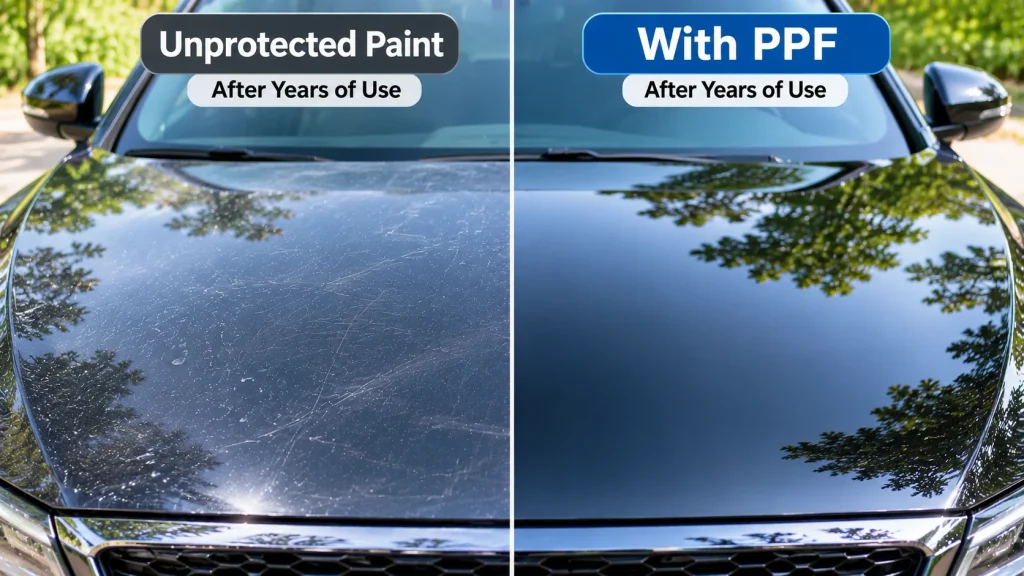
It depends on the vehicle, your driving, how much coverage you buy, and the quality of the installation. Here’s how it breaks down by situation:
- New cars: PPF protects paint from day one, before chips start. It makes the most sense on cars you plan to keep for years.
- Luxury and sports cars: appearance and originality are a big part of the value, so full-front or full-body coverage is easier to justify.
- Daily drivers: a partial or full front is usually the sweet spot. Full body is hard to justify financially for most people.
- Highway commuters and gravel-road drivers: you’ll collect chips faster, which strengthens the case.
- Long-term owners: the longer you keep the car, the more years of use you get from the cost.
- Older or low-value cars: if the film costs more than a meaningful share of the car’s value, it’s probably not worth it.
Typical 2026 US prices (verify with local quotes):
| Coverage | Typical range | Notes |
|---|---|---|
| Partial front | about $1,000 to $1,600 | Bumper, mirrors, part of hood and fenders |
| Full front | about $1,850 to $2,500 | Bumper, full hood, full fenders, mirrors |
| Track package | about $2,500 to $4,500 | Full front plus rockers and other zones |
| Full body | about $5,000 to $8,000+ | Edmunds reports installs as high as $8,000 |
These ranges come from a September 2026 pricing survey of detailers, and Edmunds reports similar highs. Prices vary by region, film brand, vehicle shape, and paint prep. Cars with swirls or scratches may need paint correction first, which adds cost.
Paint Protection Film vs. Ceramic Coating
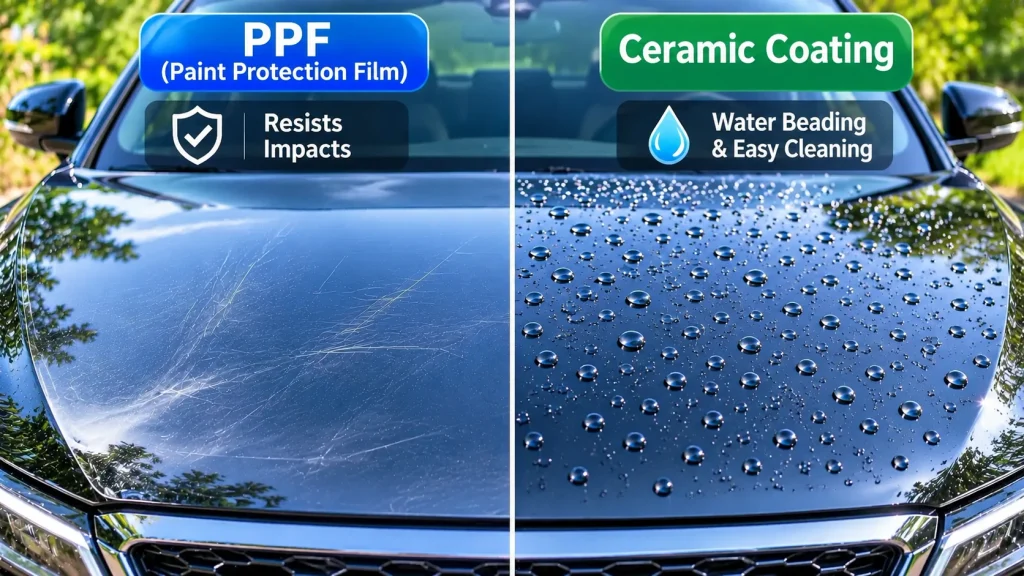
These two products solve different problems.
| Paint protection film | Ceramic coating | |
|---|---|---|
| What it is | Thick, flexible polyurethane film | Thin liquid layer that cures on the paint |
| Rock chip protection | Yes, absorbs minor impacts | No meaningful protection |
| Scratch protection | Good for light to moderate scratches; self-healing on many films | Limited; may reduce very light wash marks |
| Chemical and contaminant resistance | Good, with a stain-resistant topcoat | Strong; main strength |
| Ease of cleaning | Easier than bare paint | Strongly hydrophobic; easy to clean |
| Gloss | Preserves factory look | Can add depth and shine |
| Cost | Higher (from about $1,000 for partial front) | Lower; often quoted up to roughly $3,000 |
| Durability | Often 5 to 10 years on quality film | Varies widely; entry-level products may last 1 to 2 years |
| Best for | Impact and abrasion protection | Gloss, easy washing, chemical resistance |
Ceramic coating doesn’t create a thick physical shield and shouldn’t be expected to stop rock chips or deep scratches. PPF is the better choice for impact protection. Ceramic is the better value if your main goals are shine and easy washing.
Many owners combine them: PPF on the front end, ceramic coating on the rest of the car. Some shops also coat over the film, though opinions differ on whether that’s necessary.
Potential Drawbacks of Paint Protection Film
PPF has real downsides, and quality varies widely between films and installers.
- Upfront cost: it’s one of the more expensive ways to protect paint.
- Professional installation is essential: poorly fitted film can show visible edges, bubbles, lifting, or trapped contamination.
- Edge lines: even good installs can show thin lines where film ends, and dirt can collect at edges over time. Installers who disassemble trim and wrap edges reduce this, at higher cost.
- Aging: depending on quality, exposure, and care, film may eventually yellow, stain, crack, or peel.
- Maintenance: you still need to wash it, and gently around edges.
- Replacement: damaged or worn film needs to be replaced, which adds cost.
- Warranty limits: XPEL’s 10-year warranty, for example, focuses on specified film defects rather than damage to the paint or every type of scratch.
- Removal depends on the paint: PPF is designed to be removable, but factory paint in good condition is a better starting point than a poorly repainted panel or one with failing clear coat.
Before you book, ask the installer to show recent work, name the film brand, explain how they handle edges, inspect your paint, and describe what happens if the film must be replaced.
How Long Does Paint Protection Film Last?
XPEL says PPF typically lasts between 5 and 10 years, depending on film quality and conditions, and offers a limited 10-year warranty covering yellowing, blistering, cracking, and delamination on certain films. Those are manufacturer figures, not guaranteed real-world lifespans.
What affects durability:
- Film quality: budget films tend to be thinner and age faster.
- Installation quality: poor prep or stretching can cause early lifting.
- Climate and sun exposure: heat, UV, and road salt all take a toll.
- Vehicle use: highway miles and gravel roads wear film faster.
- Maintenance: regular gentle washing helps; neglect shortens life.
- Warranty conditions: warranties often require professional installation and proper care.
Owner reports vary. Some say film looks great after many years, while others note dirt at the edges after four years and recommend replacing it around the five-year mark depending on conditions.
Who Should Consider PPF?
- New car buyers: protect paint from the first day, ideally before the first chip.
- Luxury and sports car owners: preserve original paint on high-value vehicles.
- Highway commuters: a full front is often the best use of money.
- Truck and SUV owners: front-end and rocker panel coverage helps on gravel and trails.
- Owners in high-sun or harsh-weather areas: film adds a sacrificial layer against wear.
- Budget-minded drivers: start with a partial front, or consider ceramic coating alone.
- Owners of older, low-value cars: probably skip it.
Frequently Asked Questions
1. What are the main benefits of paint protection film? Protection against rock chips, light scratches, and stains; self-healing on many films; easier cleaning; and preservation of the original paint.
2. Is paint protection film worth it on a new car? Often, yes, especially if you’ll keep the car several years or drive a lot on highways. A partial or full front is the common compromise.
3. Does PPF protect against rock chips? Yes, it absorbs minor impacts, but a sharp or heavy strike can still tear it.
4. Can paint protection film heal scratches? Many premium films self-heal light scratches with heat from sun or warm water. Deep cuts won’t heal.
5. How long does paint protection film last? XPEL says typically 5 to 10 years, depending on film quality and conditions. Treat that as a manufacturer estimate.
6. Does PPF damage a car’s paint? Not normally on good factory paint. Risk rises on repainted panels or failing clear coat, and with poor removal technique.
7. Is paint protection film better than ceramic coating? For impact and scratch protection, yes. For gloss and easy washing, ceramic coating is strong and cheaper. Many owners use both.
8. Can paint protection film turn yellow? Lower-quality films can. Premium films often carry warranties against yellowing, but warranties have limits.
9. How much does paint protection film cost? Roughly $1,000 to $1,600 for partial front, $1,850 to $2,500 for full front, and $5,000 to $8,000+ for full body, per 2026 US pricing data. Local quotes vary.
10. Can paint protection film be removed? Yes, it’s designed to be removable. Professional removal is the safest option, particularly on older film or repainted surfaces.
11. Does PPF protect against scratches? It protects against light to moderate scratches and scuffs. Deep gouges can cut through the film.
12. Should I apply PPF to the entire car or only the front? Most drivers get the best value from full-front coverage. Full body makes more sense for high-value or enthusiast cars.
Conclusion
The biggest advantages of paint protection film are real impact protection against rock chips, defense against everyday scratches, self-healing on light marks, and preserving the original paint. The benefits tied to resale value, UV protection, and repair savings are real but conditional, and shouldn’t be treated as guarantees.
PPF makes the most sense for new, expensive, or enthusiast vehicles, and for drivers who rack up highway miles. For most people, protecting the front end with a quality film and a skilled installer is the smart middle ground. If you’re happy living with the occasional chip, it may not be worth it for you.
Get two or three quotes, ask to see an installer’s work, and compare warranties before you decide.