
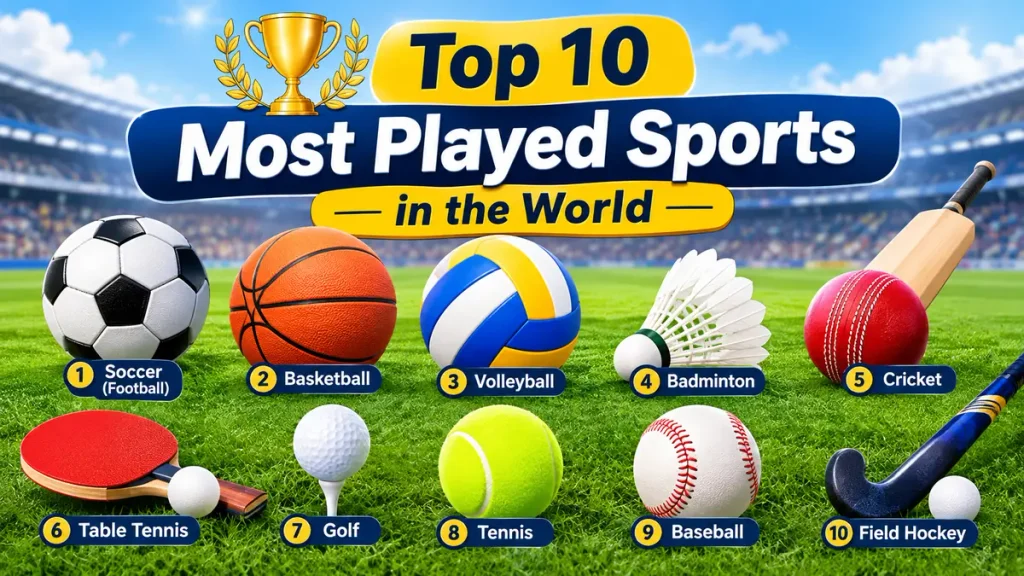
Somewhere in the world right now, kids are kicking a ball down a dusty street, office workers are trading rallies over a ping-pong table, and neighbors are setting up stumps for an evening cricket match. The top 10 most played sports in the world each draw tens or hundreds of millions of participants, a scale no stadium or TV rating can capture.
But “most played” and “most watched” are different things. A sport can fill living rooms with billions of viewers while relatively few people play it, and a game you rarely see on American TV can have hundreds of millions of regular players. This ranking focuses on people who actually play, using the latest figures from international federations, commissioned surveys and official reports.
One warning up front: sports don’t count players the same way, and some numbers are older than you’d expect. We show our work, flag the weak spots and explain why the world’s most played sports don’t always match what Americans grew up with. First, how we ranked them.
How We Ranked the Most Played Sports in the World
There is no single worldwide sports census. So we took the latest participation figure published by each sport’s international governing body, or by research it commissioned, and weighed three things:
- Size: how many people play, based on the most recent figure available.
- Reach: how many countries organize and genuinely play the sport.
- Data quality: whether the number comes from a defined survey or census, or from a loose estimate.
Data quality matters because federations count differently. FIBA counts people aged 6 to 54 who play basketball at least twice a month. The International Tennis Federation (ITF) counts anyone who played at least once in the past year. The International Cricket Council (ICC) figure covers only adults over 16. Volleyball’s headline number is the biggest on our list, but it is a broad estimate with no published definition, and the same federation was citing about 500 million not long ago.
So we did not simply sort by the biggest number. A sport with a clearly defined count and truly global reach ranks above one with a larger but vaguer claim. That is an editorial judgment, which is why the comparison table later in this article shows every raw figure and its source, so you can re-rank the list yourself.
What we left out. Fan base and TV viewership aren’t ranking factors here; we cover them separately below. Running, swimming, cycling and walking are enormously popular, but they are fitness activities rather than organized sports with federation counts. The often-quoted figure of 621 million runners traces back to a commissioned research estimate, not a governing body, so we kept it out of the ranking. Rugby, at roughly 8.4 million players, narrowly missed the cut.
A note on limits. FIFA’s last full global census, the Big Count, dates to 2006. Several other figures come from federation press materials rather than audited data. Treat every number here as a ballpark, not an exact count.
The Top 10 Most Played Sports in the World
#10 – Field Hockey
- Estimated number of players: About 30 million (federation estimate)
- Countries where it is popular: India, Pakistan, the Netherlands, Germany, Belgium, Australia, Argentina, England
- Global reach: The International Hockey Federation (FIH) cites roughly 136 nations playing some form of hockey
- Major international competition: FIH Hockey World Cup and the Olympic Games
- Popularity in the United States: A school and college sport, especially for girls and women
Field hockey is the original “hockey” for much of the world. Two teams of 11 use curved sticks to strike a small, hard ball with the flat side only, trying to score on grass or artificial turf.
The player count is a federation estimate that bundles several formats, including indoor hockey and the five-a-side Hockey5s. The FIH has cited more than 30 million participants in about 136 nations, and says millions of people play in communities across more than 150 countries. Counts like that are soft, so think of them as a range.
The sport’s staying power comes from strong school and club traditions in Europe, South Asia and Australia, and from a long Olympic history that dates to 1908. The main hurdle is infrastructure: modern competition wants artificial turf, and the FIH certified more than 200 new fields in 26 countries in 2025 alone. Hockey5s has spread fast, too, reportedly played in 59% of FIH-affiliated countries.
In the U.S.: Most American players are girls and women in high school and college programs, especially in the Northeast and Mid-Atlantic. Ice hockey gets the attention, but field hockey quietly feeds a pipeline of college athletes.
#9 – Baseball and Softball
- Estimated number of players: About 65 million (World Baseball Softball Confederation estimate, baseball and softball combined)
- Countries where it is popular: United States, Japan, Dominican Republic, Cuba, Venezuela, Mexico, South Korea, Taiwan
- Global reach: More than 140 countries and territories
- Major international competition: World Baseball Classic, WBSC Premier12, Olympic Games
- Popularity in the United States: Very high participation; about 10% of Americans name baseball their favorite sport to watch
Baseball and softball share a bat-and-ball DNA but differ in pitching style, field size and ball. They are governed together by the WBSC, which estimates about 65 million players, mostly young athletes between the ages of 5 and 21.
Because the WBSC combines the two sports, the figure covers a wide range of play, from Little League to professional ball. It is a federation estimate, not an audited census. The sport’s strongest bases are North America, East Asia and the Caribbean, where baseball is woven into national identity. Softball, meanwhile, is especially popular among girls and women worldwide.
Baseball’s global ceiling is limited by equipment, field requirements and a lack of a tradition outside a few regions. The WBSC says it wants to grow the sports’ combined audience of players and fans toward one billion, an ambition rather than a measured number. Its return to the Olympic program for Los Angeles 2028 is part of that push.
In the U.S.: The WBSC reported close to 16.7 million baseball participants in 2023, and about 25.3 million when softball is included. Gallup’s 2026 poll, though, shows baseball as the favorite sport to watch for about 10% of Americans, down from an average of 18% through the mid-1990s.
#8 – Tennis

- Estimated number of players: About 106 million (ITF Global Tennis Report, 2024; played at least once in the past year)
- Countries where it is popular: United States, Spain, France, Britain, Italy, Argentina, Japan, China
- Global reach: Data from 199 nations
- Major international competition: Australian Open, Roland-Garros, Wimbledon, U.S. Open; Olympic Games
- Popularity in the United States: 27.3 million players in 2025, a record
Tennis is one of the few sports with a recent, large-scale participation study. The ITF’s 2024 report found nearly 106 million people played at least once in the previous year, up from 84.4 million in 2019, an increase of about 25.6%. Asia leads with 35.3 million players, or 33.4% of the world total.
Two caveats matter. First, “played at least once” includes casual players, so the figure is generous compared with sports that count only regular players. Second, the ITF notes that Britain has the highest share of its population playing of any nation in the report.
Tennis spreads because the basics are simple: a racket, a ball and a court. The ITF counts 698,034 courts worldwide, 91.2% of them outdoors. The ITF’s stated goal is 120 million players by 2030.
Interesting fact: Wimbledon, which began in 1877, is the oldest tennis tournament in the world.
In the U.S.: The USTA says 27.3 million Americans played in 2025, its sixth straight year of growth, including 14.5 million who played 10 or more times and 4.9 million first-timers. Its target is 35 million by 2035.
#7 – Golf
- Estimated number of players: About 112.2 million adults and juniors playing in all forms outside the U.S. and Mexico (The R&A, 2025)
- Countries where it is popular: United States, Japan, Canada, South Korea, England, Germany
- Global reach: 149 countries affiliated with The R&A
- Major international competition: The four men’s majors, Ryder Cup, Olympic Games
- Popularity in the United States: The country with the most golfers in the world
Golf is played over 9 or 18 holes, with players trying to finish the course in the fewest strokes. It is also the sport where “played” can mean the most different things.
The R&A’s 2025 report counts 112.2 million people playing “in all its forms,” which includes driving ranges, simulators and short-course formats, not just full rounds. That excludes the U.S. and Mexico, which the R&A does not cover. For a tighter measure, the 2023 report counted 39.6 million adults playing on 9- or 18-hole courses in the same markets. Both numbers are legitimate; they answer different questions.
The R&A reports 18,500 courses in its affiliated nations, and Japan, Canada, South Korea, England and Germany lead its 2023 list of on-course markets. Women make up almost a quarter of registered adult golfers there, and junior participation is rising fast.
Golf’s appeal is lifelong: it suits both a 12-year-old and a 70-year-old, and handicaps let mixed-ability groups compete. Cost and course access are the main limits.
In the U.S.: America has more golfers than any other country, and golf’s mix of courses, driving ranges and entertainment venues keeps it widely accessible.
#6 – Table Tennis
- Estimated number of players: About 300 million (widely cited industry estimate; no primary census found)
- Countries where it is popular: China, Japan, South Korea, Germany, Sweden, France
- Global reach: 227 national associations, the most of any international federation
- Major international competition: World Table Tennis Championships; Olympic Games
- Popularity in the United States: 15.9 million participants in 2025
Table tennis, or ping-pong, shrinks tennis onto a table: players hit a light ball back and forth with paddles, and games go to 11 points.
The 300 million figure is frequently repeated in industry coverage, but we could not trace it to an audited survey, so it carries real uncertainty. What is solid is reach. In 2017, the International Table Tennis Federation (ITTF) became the first international federation to count a member association from every country and territory on earth. It now lists 227.
That footprint makes sense. A table, two paddles and a ball fit in a basement, school hallway or park. It works in any climate, at any age, and requires almost no space. China dominates elite competition, but casual play happens everywhere.
Table tennis became an Olympic sport at Seoul 1988, and its world championships have run since 1926.
In the U.S.: The Sports & Fitness Industry Association counted 15.9 million American table tennis participants in 2025, more than squash, racquetball and padel combined in that same report.
#5 – Cricket
- Estimated number of players: More than 300 million adults aged 16 and over (ICC and Nielsen research, 2018)
- Countries where it is popular: India, Pakistan, Bangladesh, Sri Lanka, Australia, England, South Africa, West Indies
- Global reach: 100+ ICC member nations
- Major international competition: ICC Cricket World Cup, T20 World Cup; returns to the Olympics in 2028
- Popularity in the United States: Small but growing
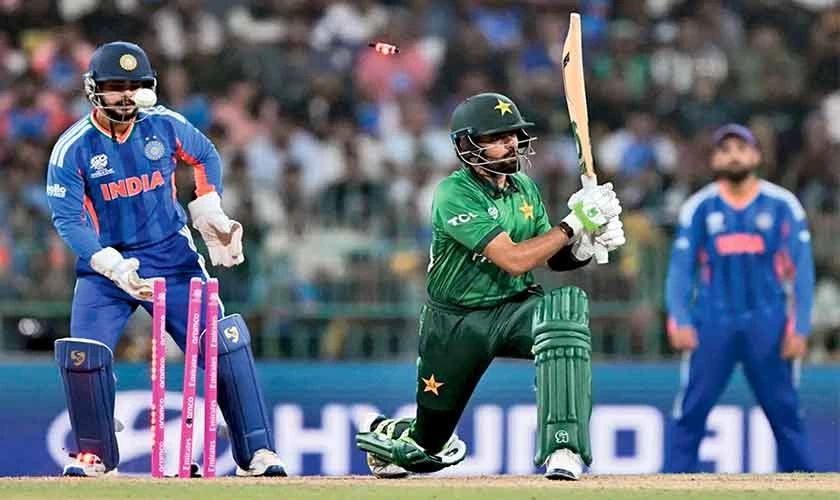
Cricket pits two teams of 11 in a bat-and-ball contest where one side scores runs while the other tries to get batters out. Matches can last five days (Test cricket) or about three hours (Twenty20).
The ICC’s 2018 market research, conducted with Nielsen, found more than 300 million active participants over age 16, and noted the real total would be significantly higher if under-16s were counted. It also found more than a billion fans in the surveyed 16-to-69 age range, with nearly 90% on the subcontinent.
Cricket’s weight is concentrated. India alone gives the sport enormous scale, and the Indian Premier League is among the most valuable leagues in the world per match. The ICC says three-quarters of its members play only T20, which is how the game is spreading into new countries.
Interesting fact: You will often see “2.5 billion cricket fans” online. The ICC’s own research reported just over a billion, so treat the larger figure with caution.
In the U.S.: Cricket is popular among South Asian and Caribbean communities. The U.S. co-hosted the 2024 T20 World Cup, and Major League Cricket launched in 2023. With cricket returning at Los Angeles 2028, expect more attention.
#4 – Badminton
- Estimated number of players: About 339 million (BWF-commissioned Nielsen report, 2019); other published claims range from 220 million to 384 million
- Countries where it is popular: China, Indonesia, Malaysia, India, Japan, South Korea, Denmark
- Global reach: Close to 200 national associations
- Major international competition: BWF World Championships, Thomas Cup; Olympic Games
- Popularity in the United States: Mostly recreational and community play
Badminton is played with lightweight rackets and a feathered shuttlecock that players hit over a net. Matches are played to 21 points in a best-of-three format, using a rally-point system introduced in 2006.
Here the spread of published figures is wide. The Badminton World Federation (BWF) has cited more than 339 million players from a Nielsen study in 2019, its corporate pages list 384 million, and other sources use 220 million. We use 339 million as the best-documented figure, but the real number is uncertain.
The sport traces back to British India in the mid-1800s and was formally organized in England. Today, East and Southeast Asia dominate it, and China has long been the powerhouse in international competition. Badminton became a full Olympic sport in 1992, and Para badminton debuted at the Tokyo Games.
It’s popular because it’s cheap and flexible: a backyard, a park or a gym works, and beginners can rally within minutes.
In the U.S.: Badminton is far less prominent than in Asia, though it’s a staple of school gym classes and community clubs. Team USA itself has noted that badminton may not be popular in the United States but is thriving elsewhere.
#3 – Volleyball
- Estimated number of players: About 800 million claimed by the sport’s federation and the IOC; older federation estimates were about 500 million
- Countries where it is popular: Brazil, Poland, Italy, the United States, Japan, China, Serbia
- Global reach: 222 national federations
- Major international competition: FIVB World Championships; Olympic Games (indoor and beach)
- Popularity in the United States: Strong in schools, colleges and on beaches
Volleyball was invented in 1895 by William Morgan, a YMCA instructor in Massachusetts, as a gentler alternative to basketball. Two teams hit a ball over a net and try to ground it on the other side. Teams were standardized at six players in 1918.
Volleyball has the biggest headline number on our list, and that’s why this entry needs the most caution. The roughly 800 million figure is widely repeated, including by the International Olympic Committee, but no clear definition of “player” is published. An older, widely cited estimate was about 500 million players, 33 million of them licensed. Even the lower number is enormous, which is why volleyball sits in our top three despite the data question.
The game’s power is its flexibility. It plays indoors, on a beach, on grass, in a park and in school gyms. The beach version has added a glamorous Olympic profile, and sitting volleyball is a Paralympic sport.
In the U.S.: Volleyball is a major girls’ high school and college sport. In Gallup’s 2026 poll, it sits in a group of sports (with ice hockey, auto racing and MMA) that 2% to 4% of Americans call their favorite to watch.
#2 – Basketball
- Estimated number of players: More than 610 million (FIBA; ages 6 to 54, playing at least twice a month)
- Countries where it is popular: United States, China, Philippines, Spain, Serbia, Lithuania, Brazil, Australia
- Global reach: More than 210 national federations
- Major international competition: FIBA Basketball World Cup; Olympic Games
- Popularity in the United States: About 11% name it their favorite sport to watch
Basketball was invented in 1891 by James Naismith in Springfield, Massachusetts. Two teams of five try to shoot a ball through a raised hoop, and the sport’s rules are famously easy to grasp.
This is one of the best-defined figures in the ranking. FIBA’s count of 610 million is specific: ages 6 to 54, playing at least twice a month. That’s a stricter standard than “played at least once this year,” which is why we put basketball second despite volleyball’s bigger claim.
Global reach is built on simple equipment, a hoop that can be nailed to a wall and a half-court game that works with two or three people. School programs, street courts and the NBA’s global fandom feed it. FIBA’s 2024 migration report found international players made up 18% of NBA rosters.
Interesting fact: China is widely reported to have the largest basketball-playing population, though exact national counts are not formally published.
In the U.S.: Basketball is the second-most popular sport to watch in Gallup’s 2026 poll (11%), behind football (31%), and ahead of baseball (10%) and soccer (9%). It is especially popular among younger and Black Americans.
#1 – Soccer (Association Football)

- Estimated number of players: About 265 million players, plus roughly 5 million referees and officials (FIFA Big Count, 2006)
- Countries where it is popular: Nearly everywhere: Brazil, Argentina, England, Spain, Germany, Nigeria, Mexico, Japan
- Global reach: 211 FIFA member associations
- Major international competition: FIFA World Cup (2026 hosted by the U.S., Canada and Mexico)
- Popularity in the United States: A record 9% name it their favorite sport to watch
Soccer is simple: two teams of 11 try to put the ball in the other’s goal without using their hands. It is called football in most of the world.
The 265 million figure comes from FIFA’s 2006 Big Count, which remains the last full global census the sport commonly cites. It’s dated, and soccer has grown since, but the Big Count is the only standardized participation count in this ranking that spans more than 200 associations. By headline numbers alone, soccer is not the largest, but it ranks first here because it combines a well-documented count with the broadest and deepest reach of any sport.
It works because it asks so little: a ball, open space and a few friends. Goals can be two backpacks. Professional leagues exist in nearly every country, and the first World Cup in 1930 had just 13 teams. Today it’s the biggest single sporting event on earth.
Interesting fact: FIFA’s 2006 census also counted around 5 million referees and officials, which is more than the population of many countries.
In the U.S.: Soccer has the most registered youth players of any team sport in many American communities and hit a record 9% in Gallup’s 2026 favorite-sport poll, shortly after the U.S. co-hosted the World Cup.
Comparison Table: The 10 Most Played Sports at a Glance
| Rank | Sport | Estimated players (source, year) | Major regions | Popularity in the USA |
| 1 | Soccer | ~265 million (FIFA Big Count, 2006) | Europe, Latin America, Africa, Asia | Growing; 9% favorite to watch |
| 2 | Basketball | 610 million+ (FIBA; ≥2x/month, ages 6–54) | Asia, Americas, Europe | Very high; 11% favorite |
| 3 | Volleyball | ~800 million claimed (FIVB/IOC); older estimate ~500 million | Europe, Americas, Asia | Strong in schools and on beaches |
| 4 | Badminton | ~339 million (BWF/Nielsen, 2019); claims range 220–384 million | East and Southeast Asia, Europe | Mostly recreational |
| 5 | Cricket | 300 million+ adults 16+ (ICC/Nielsen, 2018) | South Asia, Commonwealth | Small but growing |
| 6 | Table tennis | ~300 million (industry estimate) | Asia, Europe | 15.9 million participants (2025) |
| 7 | Golf | 112.2 million, all formats, excl. U.S./Mexico (R&A, 2025) | Asia, Europe, North America | Very high; most golfers of any country |
| 8 | Tennis | ~106 million (ITF, 2024; ≥1x/year) | Asia, Europe, Americas | 27.3 million players (2025) |
| 9 | Baseball/softball | ~65 million (WBSC) | U.S., East Asia, Latin America | 16.7 million baseball (2023); 10% favorite |
| 10 | Field hockey | ~30 million (FIH estimate) | Europe, South Asia, Australia, Argentina | School and college women’s sport |
These figures use different definitions and are not directly comparable. Treat them as estimates, not exact counts.
Which Sport Is the Most Played in the World?
Soccer is generally considered the most played sport in the world, and our ranking agrees. The honest nuance is that several sports, including volleyball and basketball, publish larger headline numbers. But those figures rely on looser or different definitions, while soccer pairs a documented, standardized count with unmatched reach.
The reach is the real story. FIFA counts 211 member associations, and the sport is played in virtually every country, in cities, villages and refugee camps alike. It requires almost no equipment, adapts to any space, and appeals to children, adults and older players. Professional leagues, continental championships and the World Cup keep its profile high, which in turn pulls in more players.
It’s also worth separating this from fan base. “Most played” asks who is on the field; “largest fan base” asks who is watching. Soccer leads both, but the gap between them is wider for sports like cricket, which has far more fans than active players in many markets.
Which Sport Has the Largest Fan Base?
Soccer, by a clear margin. The figure you will see most often is about 3.5 billion fans, but we could not trace it to a single primary study, so treat it as a widely repeated estimate rather than a measurement. FIFA has reported that its 2022 World Cup reached roughly 5 billion people in some way, though “reach” counts anyone who engaged with the tournament at all.
Cricket is usually listed second. The often-quoted 2.5 billion fans is also hard to verify. The ICC’s own 2018 research with Nielsen found just over 1 billion fans aged 16 to 69, with nearly 90% on the subcontinent. That is still a huge audience, but well below the popular claim.
Fan estimates for basketball vary wildly, from under a billion to more than two billion, depending on how “fan” is defined. That’s the core problem: a fan could be someone who watches every game, someone who watches the final, or someone who simply knows the sport exists. Rankings by fan base are useful for scale, but weaker for comparison than they look.
Most Popular Sports in the United States
American preferences look quite different from global participation trends. Gallup’s August 2026 poll found that football remains Americans’ favorite sport to watch at 31%, though that is its lowest level since 2001. Basketball came next at 11%, then baseball at 10% and soccer at 9%, a record for soccer. Twenty percent said they had no favorite sport, the highest in Gallup’s trend. Ice hockey, volleyball, auto racing and MMA each drew 2% to 4%.
The age gap is striking. Just 20% of adults aged 18 to 34 name football their favorite, compared with 38% of those 55 and older. Younger adults split more evenly among basketball, baseball and soccer.
Participation tells a different story than viewing. In 2025, tennis reached 27.3 million U.S. players, and pickleball reached 24.3 million, up from just 4.2 million in 2020, according to industry data. Baseball drew about 16.7 million in 2023 and table tennis about 15.9 million in 2025.
The takeaway: American football, which dominates U.S. television, is barely played outside North America, while the world’s most played sports, including soccer, basketball and volleyball, are all gaining ground in the U.S. This section doesn’t change the worldwide ranking, but it helps explain why America’s sports map looks so different from everyone else’s.
Why Are Some Sports More Popular Than Others?
A few practical factors do most of the work.
Cost and equipment. Soccer needs a ball. Table tennis needs a table and two paddles. Golf needs clubs, courses and time. The lower the barrier, the bigger the participation base.
Space and facilities. Badminton and volleyball adapt to a backyard or beach. Field hockey wants specialized turf, and baseball needs a diamond.
Climate and geography. Beach volleyball thrives on coasts; indoor sports like table tennis and badminton flourish where weather limits outdoor play.
Culture and history. Colonial history spread cricket and field hockey, while the YMCA spread basketball and volleyball. Once a sport becomes part of local identity, it passes down through families.
Schools and leagues. Physical education programs are a huge on-ramp. Professional leagues and global events like the World Cup and the Olympics create heroes kids want to imitate.
Ease of learning and group size. Sports that can be played with two people, or a casual group of any size, are far easier to organize than those needing two full teams and a specific field. That’s why simple-equipment, flexible-format sports often win on recreational participation.
Frequently Asked Questions
What is the most played sport in the world? Soccer (association football) is generally considered the most played sport, with about 265 million players in FIFA’s last full census, played in virtually every country. Some sports publish larger headline numbers, but with looser definitions.
What are the top 10 most played sports in the world? In our ranking: soccer, basketball, volleyball, badminton, cricket, table tennis, golf, tennis, baseball and softball, and field hockey.
Which sport has the most players worldwide? By raw federation claims, volleyball (about 800 million) and basketball (more than 610 million) top the list. Those counts use different definitions than soccer’s, so they’re not directly comparable.
Which sport has the largest fan base? Soccer, with a commonly cited estimate of about 3.5 billion fans. That figure is widely repeated but hard to trace, so it’s best treated as an estimate.
Is soccer the most played sport in the world? Yes, by most reasonable measures that combine player numbers with global reach. It isn’t the largest on every headline figure, but no other sport matches its reach.
How many people play soccer worldwide? FIFA’s 2006 Big Count estimated about 265 million players and 5 million referees and officials. That is the last full census, so the real number today is likely different.
What is the most popular sport in the United States? Football. In Gallup’s 2026 poll, 31% of Americans named it their favorite sport to watch, ahead of basketball (11%), baseball (10%) and soccer (9%).
Which sports are popular in the USA but less popular worldwide? American football is the clearest example, followed by baseball, which is concentrated in a handful of countries, and ice hockey, which is strongest in North America and parts of Europe.
What is the fastest-growing sport in the world? It depends on the measure. In the U.S., pickleball grew from 4.2 million to 24.3 million players between 2020 and 2025. Globally, tennis participation rose about 25.6% from 2019 to 2024, and golf added 4.2 million players in a year, per the R&A.
Is cricket more popular than basketball worldwide? By participation, basketball’s documented 610 million exceeds cricket’s 300 million adult players. Fan estimates for both vary widely, so there is no reliable answer on fan base alone.
Which sport is played in the most countries? Table tennis has the most federation members, with 227 associations, followed closely by soccer, with 211 FIFA members. Both reach nearly every country and territory.
What is the difference between the most played sport and the most watched sport? The most played sport counts people who participate. The most watched counts audiences. Soccer leads both, but many sports, like cricket, golf and American football, draw far more viewers than players relative to their reach.
Conclusion
The world’s most played sports are not just the biggest on TV. They’re the ones that fit into a street, a school gym or a living room. Soccer sits on top for its unmatched reach, but basketball, volleyball, badminton and cricket each draw hundreds of millions of players, and some of the numbers are bigger than the soccer count that gets so much of the credit.
Participation figures vary because sports count players differently, and fan estimates are even shakier. That’s why the best way to read any ranking is to ask what exactly is being counted.
Curious how these sports stack up on other measures? Explore more rankings on AboutTop10.com, from the most-watched sports to the biggest sporting events in the world.