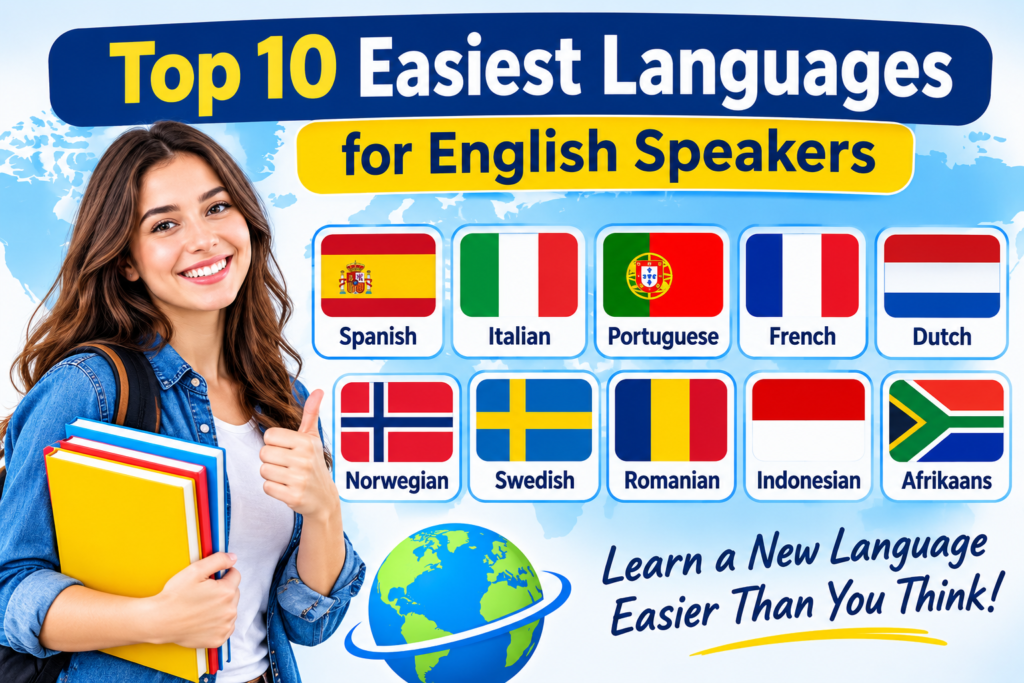
10 Easiest Languages to Learn for English Speakers
10 Easiest Languages to Learn for English Speakers
By the AboutTop10.com Editorial Team
No language is easy in the abstract. A language feels easy or hard depending on what you already know, and for English speakers, that starting point matters enormously. English is a Germanic language that borrowed heavily from French and Latin after 1066, so it shares a surprising amount of DNA with languages on both sides of its family tree. A Spanish learner meets thousands of familiar-looking words on day one. A Mandarin learner meets none.
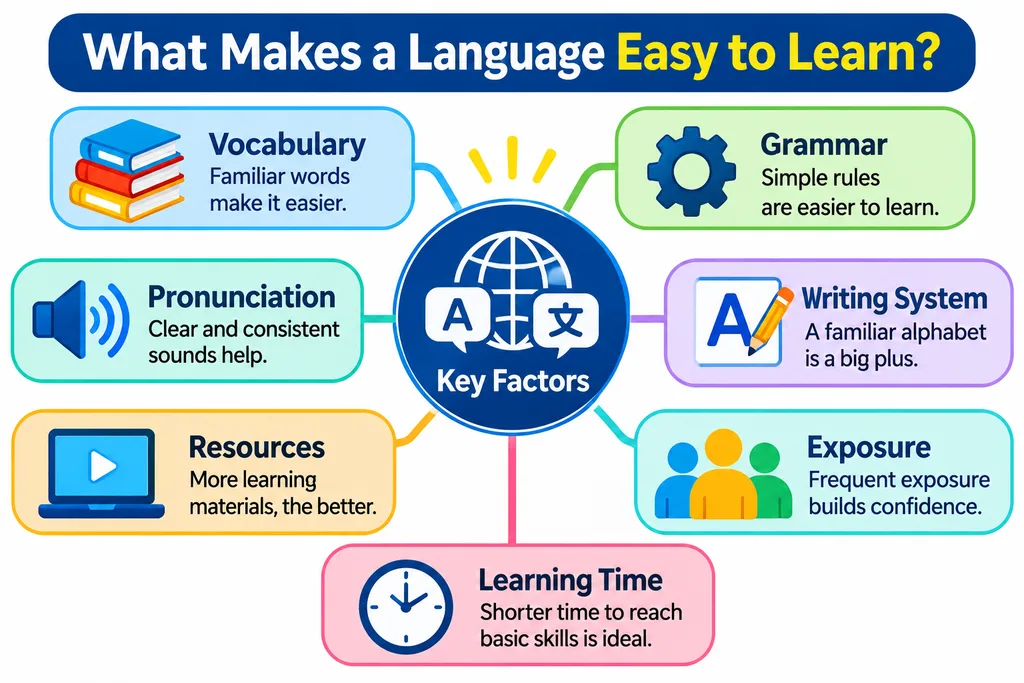
Beyond vocabulary, five things shape how hard a language feels: grammar (cases, genders, verb conjugations), pronunciation (sounds your mouth has never made), the writing system (a familiar alphabet versus thousands of characters), how much of the language you already hear around you, and how many good learning resources exist. The easiest languages to learn for English speakers tend to score well on most of these at once.
Below is our ranking of the ten easiest languages to learn, explained rather than just listed. If you want the opposite end of the spectrum afterward, see our companion guide, Top 10 Hardest Languages to Learn.
How We Ranked the Easiest Languages to Learn
We weighed seven factors. None is a perfect measure, and a different learner could reasonably order the list differently.
- Vocabulary similarity to English: how many cognates (words with shared ancestry, such as family and familia) a beginner can recognize.
- Grammar complexity: verb conjugations, grammatical gender, cases, and word order quirks.
- Pronunciation and speaking difficulty: unfamiliar sounds, stress, tones, and how closely spelling matches speech.
- Writing system: all ten languages here use the Latin alphabet, which removes a major barrier.
- Availability of learning resources: apps, courses, textbooks, podcasts, and tutors.
- Cultural and practical exposure: music, TV, travel, and communities where you can actually use the language.
- Estimated learning time: drawn from the U.S. Foreign Service Institute (FSI).
A note on FSI estimates. The FSI trains American diplomats and groups languages into categories by how long English-speaking students typically need to reach professional working proficiency. Category I languages are listed at roughly 24–30 weeks, or 600–750 class hours; Category II languages at about 36 weeks, or 900 class hours; and the hardest group (Arabic, Chinese, Japanese, Korean) at about 88 weeks, or 2,200 class hours. These figures describe full-time, intensive classroom study by motivated adults with extra self-study, not casual evening practice. Treat them as a way to compare languages, not as a promise about your own timeline.
10 Easiest Languages to Learn
1. Spanish
Why it’s easy. Spanish is the default recommendation for good reason. Its spelling is largely phonetic, it has just five core vowel sounds, and Latin-derived English words (animal, importante, situación) carry over almost unchanged. Resources are everywhere, from apps to streaming shows to neighbors you can practice with.
Relationship with English. Spanish is a Romance language; English borrowed a large share of its formal vocabulary from the same Latin roots. Many English words ending in -tion, -ble, and -ty map directly to Spanish -ción, -ble, and -dad.
Grammar. Moderate. Nouns have gender, verbs conjugate for every person, and the subjunctive mood and the ser versus estar distinction (two verbs for “to be”) trip up most learners. The sentence structure, however, is close to English.
Pronunciation. Gentle. The rolled r takes practice, but you can read almost any word aloud correctly once you learn the rules.
Writing system. Latin alphabet with ñ and accent marks.
Useful phrases. ¿Cuánto cuesta? (How much does it cost?) · Mucho gusto (Nice to meet you) · ¿Dónde está el baño? (Where is the bathroom?)
Learning time. FSI Category I (about 600–750 class hours).
Practical benefits. Spanish has roughly 500 million native speakers according to Ethnologue and is widely used across the Americas and Spain, making it valuable for travel, healthcare, education, and business in the United States.
Best for. Almost any first-time learner, especially those in the U.S. who will meet the language daily.
Linguistic fact. Spanish and English share the word tomato because both borrowed it from a Nahuatl word, tomatl, via Spanish.
2. Italian
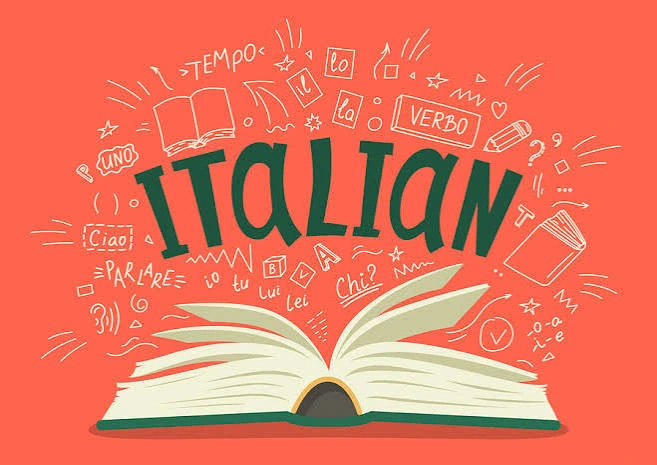
Why it’s easy. Italian is arguably the most phonetic major European language: what you see is what you say. Vowels are pure and consistent, and the melody of the language is easy to imitate.
Relationship with English. Another Romance language, with heavy cognate overlap (musica, famiglia, natura). English has also absorbed many Italian loanwords, especially in music (piano, soprano) and food (espresso, broccoli).
Grammar. Moderate. Gendered nouns, many verb tenses, and a subjunctive, but fewer exceptions than French. Pronouns are often dropped because verb endings already show who is acting.
Pronunciation. Friendly overall. Double consonants (pizza, nonno) must be held slightly longer, and the gli and gn sounds take practice.
Writing system. Latin alphabet, with a few accents.
Useful phrases. Piacere (Pleased to meet you) · Il conto, per favore (The check, please) · Non capisco (I don’t understand)
Learning time. FSI Category I.
Practical benefits. Italian opens doors in art, cuisine, fashion, design, opera, and travel. It has far fewer native speakers than Spanish (on the order of 65 million), so it is more of a passion-driven choice than a career-driven one.
Best for. Travelers, food lovers, musicians, and anyone motivated by culture.
Linguistic fact. Modern standard Italian grew largely out of the Tuscan dialect, boosted by the literary prestige of Dante, Petrarch, and Boccaccio.
3. Portuguese
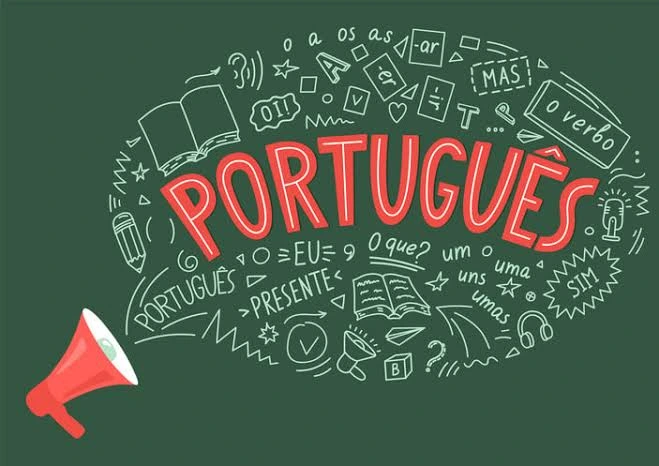
Why it’s easy. Portuguese shares the Latin-based vocabulary and grammar logic of Spanish, so learners often make quick early progress. Reading is usually easier than listening, because speech can sound compressed.
Relationship with English. Romance language with extensive cognates (natural, importante, hospital), plus classic false friends such as esquisito (weird, not exquisite).
Grammar. Moderate, similar to Spanish. Portuguese adds a distinctive “personal infinitive” (an infinitive that conjugates), which is unusual but optional for beginners.
Pronunciation. The hardest part of Portuguese. Nasal vowels (mão, pão) and reduced unstressed vowels make it sound quite different from Spanish. Brazilian and European Portuguese also differ noticeably.
Writing system. Latin alphabet with accents and the cedilla (ç).
Useful phrases. Obrigado / Obrigada (Thank you, said by a man / a woman) · Quanto custa? (How much is it?) · Tudo bem? (How’s it going?)
Learning time. FSI Category I.
Practical benefits. Portuguese is spoken by more than 250 million people worldwide, including Brazil’s very large economy, along with Portugal, Angola, and Mozambique.
Best for. Business-minded learners, Spanish speakers expanding their reach, and fans of Brazilian music and culture.
Linguistic fact. Portuguese gave English words like marmalade, albino, and piranha.
4. French
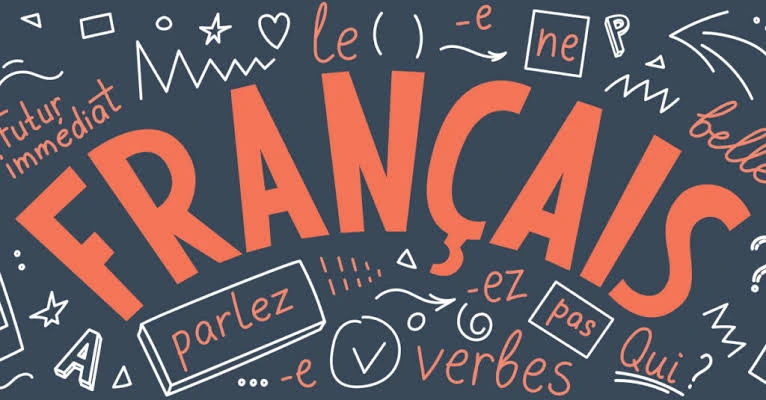
Why it’s easy (relatively). French sits high on this list because of its enormous vocabulary overlap with English. Following the Norman Conquest, French shaped English for centuries, so words like government, table, restaurant, and justice look the same in both languages. Learning resources are abundant.
Relationship with English. Romance language; its influence on English vocabulary is arguably larger than any other language besides Latin.
Grammar. Moderate to demanding. Gendered nouns, many irregular verbs, and agreement rules take time.
Pronunciation. This is where French earns its fourth-place ranking instead of first. Spelling and sound often diverge, many letters are silent, and sounds like the French r and nasal vowels are new to most English speakers.
Writing system. Latin alphabet with accents (é, è, ç, ô).
Useful phrases. Je voudrais un café (I would like a coffee) · Où est la gare ? (Where is the train station?) · Enchanté (Nice to meet you)
Learning time. FSI Category I.
Practical benefits. French is an official language in many countries across Europe, Africa, and North America (including Canada) and is a major language of diplomacy and international organizations.
Best for. Future diplomats, travelers to Europe and Africa, and anyone who wants a language that reinforces their English vocabulary.
Linguistic fact. French counts 70 as soixante-dix (“sixty-ten”) and 80 as quatre-vingts (“four twenties”), a trace of older counting systems.
5. Dutch
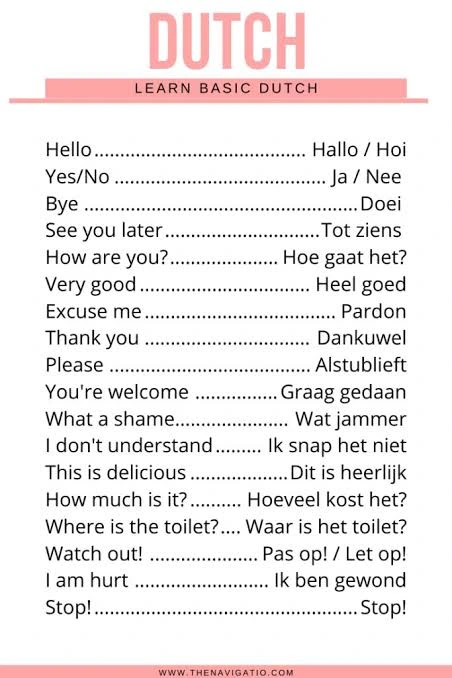
Why it’s easy. Dutch is one of the closest major languages to English. Both are West Germanic, so everyday vocabulary overlaps heavily (water, hand, winter, appel), and Dutch grammar is simpler than German’s.
Relationship with English. Close cousins. Many Dutch sentences are readable at a glance, such as Ik heb een boek (I have a book).
Grammar. Fairly accessible. Verbs conjugate simply, and Dutch has two grammatical genders in practice (common and neuter) plus a few word-order rules, such as putting the verb in second position in main clauses and at the end in subordinate clauses.
Pronunciation. The guttural g and ch sounds, and certain vowel combinations (ui, eu), take effort.
Writing system. Latin alphabet.
Useful phrases. Alstublieft (Please / Here you go) · Hoeveel kost het? (How much does it cost?) · Gezellig (cozy, pleasant, convivial)
Learning time. FSI Category I.
Practical benefits. Roughly 25 million native speakers across the Netherlands, Belgium (Flemish), and Suriname. Practice can be hard to find because many Dutch speakers switch to English quickly.
Best for. Learners who want a language close to English and an easy path toward German or Scandinavian languages later.
Linguistic fact. English words like yacht, cookie, and landscape came from Dutch.
6. Norwegian
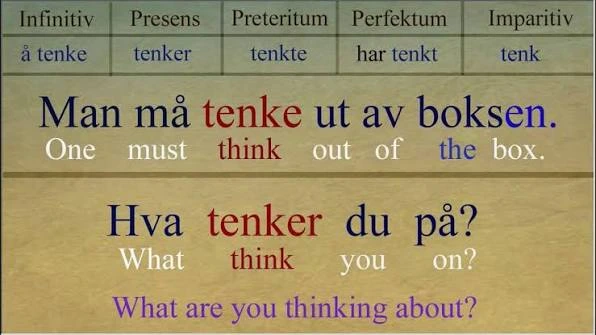
Why it’s easy. Norwegian combines Germanic roots with exceptionally simple grammar. Verbs do not change by person (I am, you are, they are all use er), which removes the biggest memorization burden in most European languages.
Relationship with English. Both descend from the Germanic branch. Old Norse also left a mark on English through Viking-era contact, giving us words like sky, egg, and window.
Grammar. Light. Three genders exist in some forms, though many speakers use only two, and the definite article attaches to the end of the noun (bok → boken, “the book”).
Pronunciation. Moderate. Norwegian has a pitch accent, and vowel sounds like y and ø are new to English speakers. Dialects vary widely, but Oslo-area speech is a good learner standard.
Writing system. Latin alphabet with æ, ø, å. Norwegian has two written standards, Bokmål (more common) and Nynorsk.
Useful phrases. Takk for maten (Thanks for the meal) · Jeg forstår ikke (I don’t understand) · Hvor er toalettet? (Where is the toilet?)
Learning time. FSI Category I.
Practical benefits. Norway has a high standard of living and strong energy, maritime, and technology sectors. Norwegian is mutually intelligible to a degree with Swedish and Danish.
Best for. Learners attracted to Scandinavia, and anyone who wants a gateway to the other Nordic languages.
Linguistic fact. Norwegians speak English very well, which is both a learning obstacle (they’ll switch to English) and a reason to be patient and insist on practicing.
7. Swedish
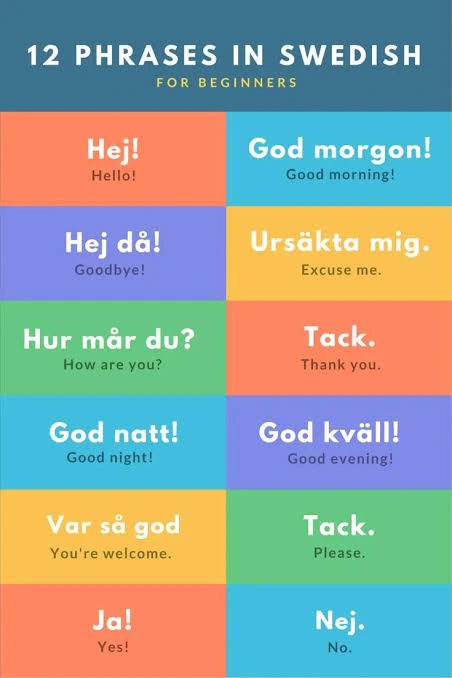
Why it’s easy. Swedish follows much of the same logic as Norwegian: verbs do not conjugate by person, vocabulary overlaps with English, and sentence structure is familiar. A huge amount of media, from crime dramas to music, is available with subtitles.
Relationship with English. Germanic cousin. Words like hus (house), vinter (winter), and fisk (fish) feel instantly recognizable.
Grammar. Light to moderate. Two genders (common and neuter), a suffixed definite article, and word-order rules similar to Dutch and German.
Pronunciation. The tricky part. Swedish has a pitch accent and the famous sj sound, which different dialects pronounce differently. Long and short vowels also matter for meaning.
Writing system. Latin alphabet with å, ä, ö.
Useful phrases. Tack så mycket (Thank you very much) · Hur mycket kostar det? (How much does it cost?) · Jag förstår inte (I don’t understand)
Learning time. FSI Category I.
Practical benefits. Sweden is home to global brands and a strong startup scene. Swedish is also an official language in Finland.
Best for. Learners interested in design, technology, and Nordic culture.
Linguistic fact. The Swedish word fika, a coffee-and-pastry break with friends or colleagues, has no tidy English equivalent and is a cultural institution.
8. Romanian

Why it’s easy. Romanian is a Romance language, so if you’ve studied Spanish, Italian, or French you’ll recognize much of its core vocabulary. It also has a quirk that makes it more distinctive than its cousins.
Relationship with English. More distant than Spanish or French, because Romanian also absorbed Slavic, Hungarian, and Turkish influence. Still, Latin-based words (națiune, important, familie) are easy to spot.
Grammar. More demanding than most languages on this list. Romanian preserves noun cases (a feature most Romance languages lost), has three genders, and attaches the definite article to the end of nouns.
Pronunciation. Relatively regular and phonetic, with a few new sounds (ă, â, î).
Writing system. Latin alphabet with diacritics.
Useful phrases. Bună ziua (Good day) · Mulțumesc (Thank you) · Cât costă? (How much does it cost?)
Learning time. FSI Category I.
Practical benefits. About 24 million native speakers in Romania and Moldova, with growing tech and outsourcing industries. Resources are fewer than for Spanish or French.
Best for. Learners with Romance language experience, travelers to Eastern Europe, and those who enjoy a challenge-light puzzle.
Linguistic fact. Romanian is the Romance language that stayed most isolated from the rest, surrounded by Slavic neighbors, which is why it kept features like cases.
9. Indonesian
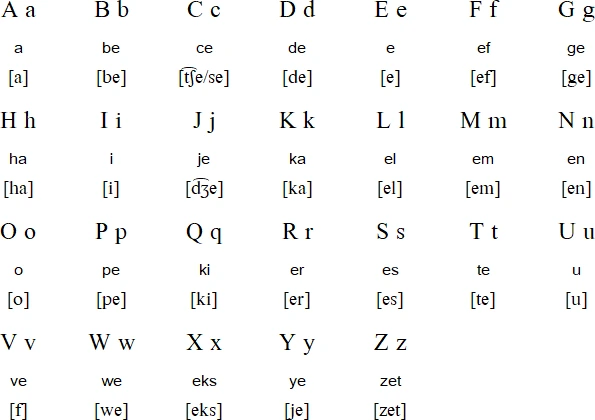
Why it’s easy. Indonesian is the outlier on this list: not European, but famously approachable. It has no verb conjugation, no grammatical gender, and no tenses. You show time with words like kemarin (yesterday) or besok (tomorrow) rather than changing the verb.
Relationship with English. Not related, but the Latin alphabet and loanwords from Dutch, English, and Arabic (telepon, restoran, universitas) help beginners.
Grammar. Very light. Plurals are often made by repeating a word (buku-buku, “books”), and sentences follow subject-verb-object order, like English. Affixes that change a verb’s meaning take practice.
Pronunciation. Highly regular and phonetic, with sounds English speakers can manage.
Writing system. Latin alphabet.
Useful phrases. Terima kasih (Thank you) · Berapa harganya? (How much is it?) · Selamat pagi (Good morning)
Learning time. FSI places Indonesian in Category II, at about 900 class hours, mostly because it is unrelated to English and has far less shared vocabulary. Many learners find early progress fast and later progress slower, especially with informal everyday speech.
Practical benefits. Indonesian serves hundreds of millions of people, most of them speaking it as a second language alongside regional languages. It is closely related to Malay.
Best for. Travelers to Southeast Asia and anyone who wants the easiest Asian language to learn from an English-speaking starting point.
Linguistic fact. Indonesian was deliberately promoted as a national unifying language in the early twentieth century, and no ethnic group claimed it as its own.
10. Afrikaans
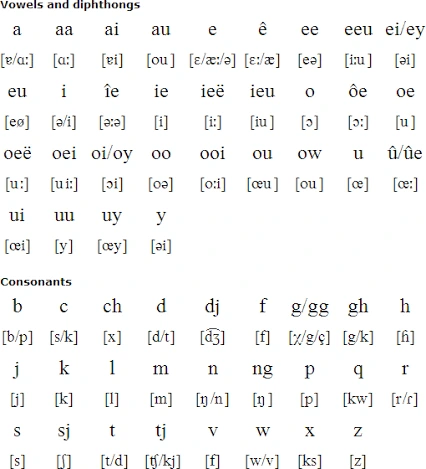
Why it’s easy. Afrikaans is a daughter language of 17th-century Dutch that simplified dramatically as it developed in southern Africa. It dropped grammatical gender, noun cases, and most verb conjugation, leaving one of the most regular grammars of any European language.
Relationship with English. Germanic and fairly close. Reading Afrikaans is often easier than speaking it. Ek het ’n appel (I have an apple) is nearly transparent.
Grammar. Very light, though double negation (Ek weet nie dit nie) and some word-order rules feel odd at first.
Pronunciation. Moderate. Guttural g and r sounds, and some unfamiliar vowels.
Writing system. Latin alphabet.
Useful phrases. Dankie (Thank you) · Hoe gaan dit? (How are you?) · Ek verstaan nie (I don’t understand)
Learning time. FSI lists Afrikaans in Category I.
Practical benefits. Roughly 7 million native speakers, mostly in South Africa and Namibia, and many more who use it as a second language. Resources are limited compared with the languages above.
Best for. Learners interested in South Africa and Namibia, or those looking for a stepping stone to Dutch.
Linguistic fact. Afrikaans has a reputation as a “Dutch simplified,” and Dutch speakers can often understand it with little effort.
Comparison Table – 10 Easiest Languages to Learn
Difficulty here refers to a typical native English speaker with no prior foreign language study. Your experience could differ.
| Language | Language Family | Difficulty for English Speakers | Main Learning Advantage | Approximate Learning Time (FSI) |
|---|---|---|---|---|
| Spanish | Romance (Indo-European) | Easy | Phonetic spelling, huge exposure | Category I, about 600–750 class hours |
| Italian | Romance | Easy | Highly regular pronunciation | Category I |
| Portuguese | Romance | Easy to moderate | Strong overlap with Spanish and English | Category I |
| French | Romance | Easy to moderate | Vast shared vocabulary with English | Category I |
| Dutch | West Germanic | Easy to moderate | Closest major cousin to English | Category I |
| Norwegian | North Germanic | Easy | No verb conjugation by person | Category I |
| Swedish | North Germanic | Easy to moderate | Simple grammar, rich media | Category I |
| Romanian | Romance | Moderate | Latin base if you know another Romance language | Category I |
| Indonesian | Austronesian | Moderate | Very simple grammar, Latin alphabet | Category II, about 900 class hours |
| Afrikaans | West Germanic | Easy | Regular grammar | Category I |
Estimates come from FSI classifications for intensive classroom study. Individual results depend on study time, method, prior language experience, and goals.
What Makes a Language Easy to Learn?
Shared vocabulary. The more words you can guess, the faster you can start reading and listening. English’s mixed Germanic and Latin heritage is why both Spanish and Dutch can feel approachable.
Familiar alphabets. Every language here uses the Latin alphabet, so you can read signs, menus, and subtitles from the first lesson. Switching to a new script, as in Russian or Korean, adds months of work.
Simple grammar structures. Fewer cases, less irregularity, and no complex verb systems lower the mental load. This is why Norwegian, Afrikaans, and Indonesian feel lighter than their relatives.
Pronunciation patterns. A language with consistent spelling, like Spanish or Italian, lets you pronounce new words correctly after learning a few rules. French and English are the opposite: spelling is famously unreliable.
Language exposure. Hearing and using a language every day beats occasional study. Living near speakers, following media, and using the language socially all speed progress.
Motivation and consistency. Research on language learning consistently points to engagement as a major factor. A language you care about and practice regularly will usually outperform a “technically easier” language you drop after three weeks.
What Is the Absolute Easiest Language to Learn?
No single language is universally the easiest. But if you force a comparison among Spanish, Italian, and Dutch for English speakers, here is how they stack up.
- Spanish: Easy pronunciation, very high exposure, and enormous resources. Grammar is moderate. Best all-around choice.
- Italian: Very phonetic and musical, with slightly fewer learning resources. Great for culture-driven learners.
- Dutch: The closest to English in vocabulary and structure, but fewer speakers and fewer chances to practice.
Spanish is the strongest overall pick for many beginners because it combines several advantages: regular spelling, familiar vocabulary, a large speaking community, and plentiful tools. Still, a learner whose heritage is Dutch or whose partner speaks Norwegian may find those languages easier in practice. If your native language is not English, the answer can change completely. For example, a Portuguese speaker will likely find Spanish far easier than an English speaker finds it.
How Long Does It Take to Learn an Easy Language?
The best-known benchmark is the FSI’s, which estimates 600–750 class hours for Category I languages to reach professional working proficiency. That is a demanding standard: it means handling work discussions and reading complex material, not just ordering dinner.
It helps to think in stages:
- Beginner (about A1–A2): You can introduce yourself, order food, and handle basic travel situations. Many motivated learners get here within a few months of regular practice.
- Intermediate (about B1–B2): You can discuss familiar topics, follow conversations, and read everyday texts, though you will still make mistakes and miss words. This often takes many months to a couple of years, depending on study time.
- Advanced (about C1–C2): You can argue a point, understand nuance, and work professionally in the language. This is a multi-year journey for most people.
Conversational ability and professional fluency are different goals. You can enjoy simple conversations long before you can write a legal memo or follow fast native speech.
Limitations of the estimates. FSI numbers come from full-time government training, not part-time study. Prior language learning, native language, study quality, and exposure all change the timeline. No estimate is a guarantee.
Tips to Learn a New Language Faster
- Practice daily, even briefly. Twenty focused minutes a day beats a three-hour weekend cram.
- Listen to native speakers. Podcasts, radio, and videos train your ear for real speed and rhythm.
- Find a language exchange partner. Trade conversation time with a native speaker who wants to learn English.
- Build vocabulary strategically. Start with the most frequent few hundred words, then expand to topics you care about.
- Speak from day one. Say simple sentences aloud, even to yourself. Waiting until you feel “ready” slows progress.
- Watch movies and videos. Start with subtitles in your own language, then switch to subtitles in the target language, then drop them.
- Read beginner-friendly content. Graded readers, children’s books, and simple news sites help you absorb grammar naturally.
- Use spaced repetition. Flashcard systems that schedule reviews based on how well you remember are one of the best-supported memory techniques.
- Set realistic goals. “Order dinner in Italian by March” is better than “become fluent.”
- Keep it consistent. Habit matters more than intensity. Attach study to something you already do, like your morning coffee.
Easiest vs. Hardest Languages to Learn
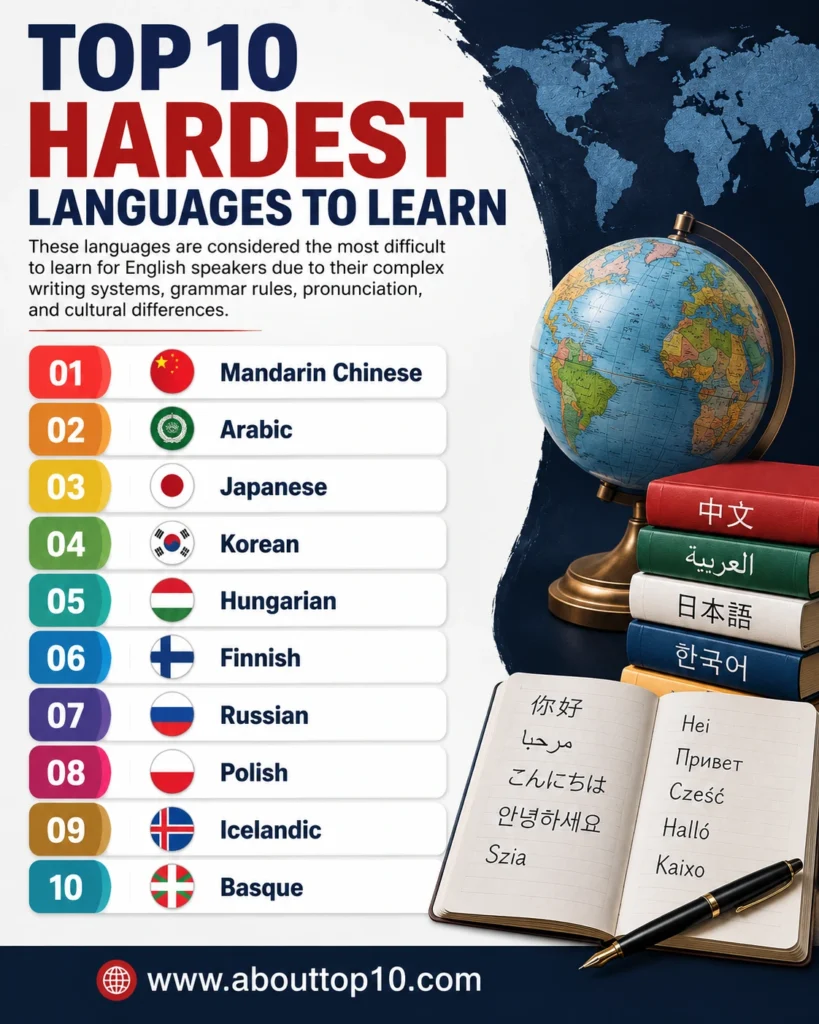
The difference between the two ends of the spectrum is not just effort; it’s the type of effort. Our guide to the hardest languages to learn covers languages like Mandarin Chinese, Japanese, Arabic, and Korean in depth. Here is how they contrast with the easy ones above.
- Writing systems. The easy languages use the Latin alphabet. Mandarin relies on thousands of characters; Japanese mixes three scripts; Arabic is written right to left in a script whose letters change shape; Korean’s Hangul is logical and learnable in days, but the rest of the language is not as simple.
- Grammar. Spanish and French demand verb conjugation. Japanese and Korean place verbs at the end and use layered politeness levels. Arabic relies on root patterns and complex plurals. Mandarin has very simple grammar in some respects but uses measure words and subtle word order.
- Pronunciation. Mandarin is tonal, so the same syllable can mean different things depending on pitch. Arabic includes throat sounds English lacks. Spanish and Italian rarely surprise your mouth by comparison.
- Vocabulary. The easy languages share thousands of words with English. For Mandarin, Japanese, Korean, and Arabic, most vocabulary starts from scratch, though modern English loanwords help a bit.
- Learning requirements. The FSI puts Arabic, Chinese, Japanese, and Korean in its hardest group, at roughly 2,200 class hours versus 600–750 for Category I languages.
None of this means harder languages are not worth learning. If you want to pursue one, an easy language first can build study habits and confidence that carry over.
Frequently Asked Questions
What is the easiest language to learn for English speakers?
For many English speakers, Spanish is the best starting point thanks to phonetic spelling, familiar vocabulary, and heavy exposure. Dutch, Norwegian, and Italian are also frequently recommended. The best choice depends on your goals and background.
What is the easiest language in the world?
There is no objectively easiest language for everyone. Difficulty depends on your native language. For English speakers, Spanish, Dutch, and Norwegian are common candidates; for someone whose first language is Portuguese, Spanish would likely be easiest.
Is Spanish easier than French?
For most English speakers, yes, mainly because Spanish pronunciation and spelling are more consistent. French shares even more vocabulary with English, but its sounds and silent letters often slow learners down.
Is Italian easy to learn?
Yes, relatively. Italian is very phonetic, shares many Latin-based words with English, and has plenty of cultural motivation. Verb conjugation and the subjunctive take work.
What language is closest to English?
Frisian is generally considered the closest living relative of English, followed by other West Germanic languages such as Dutch and Low German. Among widely studied languages, Dutch is often named closest.
Can I learn a new language in three months?
You can reach basic beginner skills, such as introductions, simple questions, and travel phrases. Professional fluency in three months is not realistic for most people, even with an easy language. Official estimates for Category I languages are measured in hundreds of class hours.
What is the easiest Asian language to learn?
Indonesian is widely regarded as one of the easiest for English speakers because of its Latin alphabet and simple grammar. Malay is similar. Among East Asian languages, all are generally more demanding.
Which language is easiest to learn for beginners?
Spanish, Italian, Norwegian, and Dutch are popular beginner choices. Pick one you’ll actually enjoy practicing, with learning resources and people to speak with.
Final Thoughts
The easiest languages to learn share a familiar alphabet, recognizable vocabulary, and manageable grammar. Spanish remains the most practical all-around pick for many English speakers, but Italian, Dutch, Norwegian, and the others offer excellent starting points depending on what excites you.
The best language to learn is the one you’ll keep practicing. Think about where you want to travel, who you want to talk to, and which culture you’re curious about, then commit to short, consistent sessions. When you’re ready for a bigger challenge, our guide to the hardest languages to learn will be waiting.